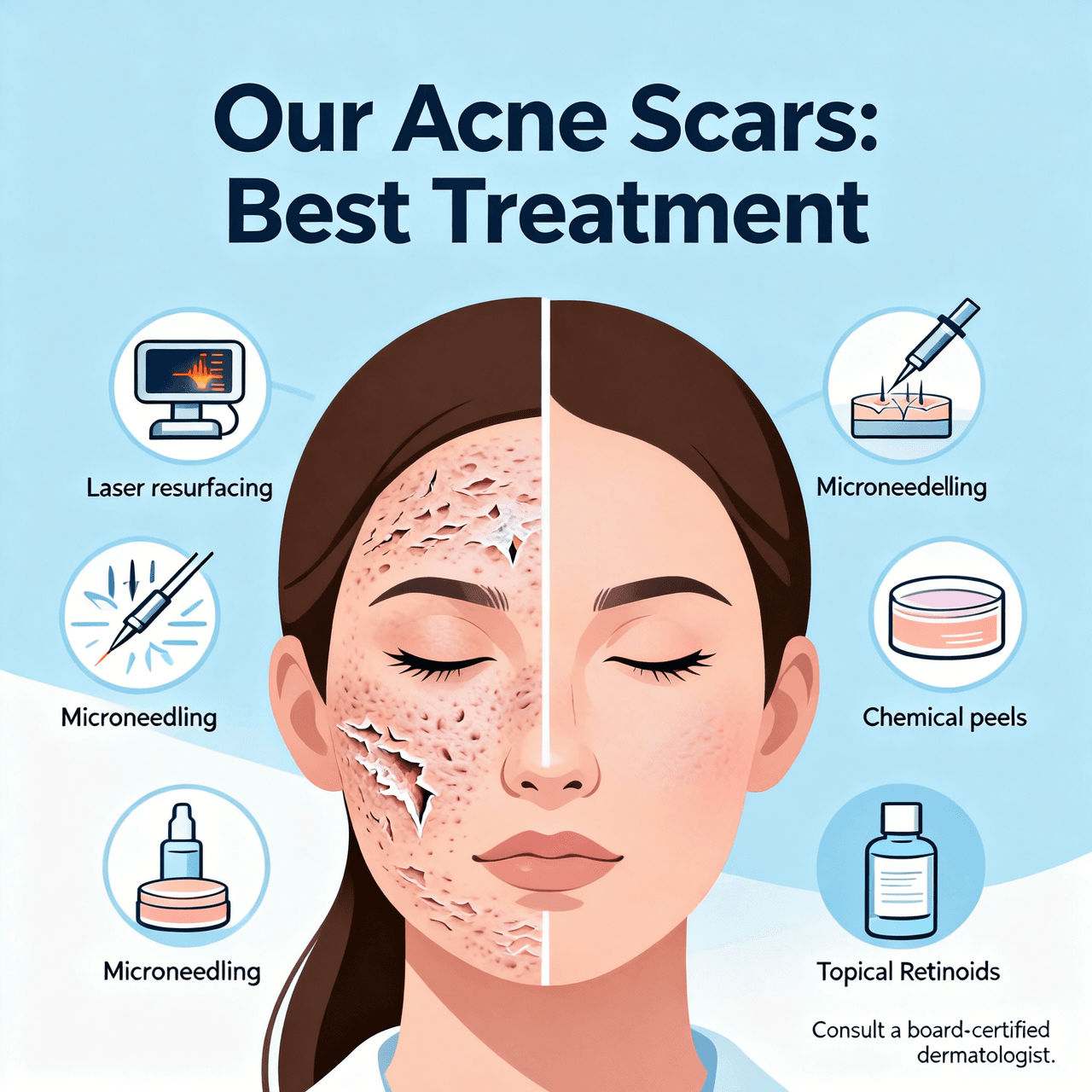
Acne scars can be a lasting reminder of past breakouts, affecting both appearance and self-confidence. Fortunately, modern dermatology offers various effective treatments to significantly improve or eliminate acne scars. This comprehensive guide covers the best treatment options available.
Understanding Acne Scars
Acne scars form when the skin's healing process is disrupted, leaving permanent texture changes.
Atrophic scars (depressed): Most common type, including ice pick, boxcar, and rolling scars.
Hypertrophic scars (raised): Less common, result from overproduction of collagen during healing.
Post-inflammatory hyperpigmentation: Dark spots left after acne heals (not true scars but often treated similarly).
Scar severity depends on factors like genetics, acne severity, and how acne was treated.
Early treatment of active acne is the best prevention for scarring.
Laser Resurfacing for Acne Scars
Fractional CO2 Laser: Removes damaged skin layers and stimulates new collagen production. Best for moderate to severe scarring.
Erbium Laser: Gentler option for mild to moderate scars with less downtime.
Non-ablative Lasers: Target deeper skin layers without removing surface skin. Minimal downtime.
Laser treatments typically require 3-5 sessions spaced 4-6 weeks apart.
Results improve gradually over 3-6 months as new collagen forms.
Most effective for atrophic scars and can improve skin texture by 50-80%.
Microneedling with PRP
Microneedling creates controlled micro-injuries to stimulate collagen and elastin production.
When combined with PRP (Platelet-Rich Plasma), results are significantly enhanced.
PRP contains growth factors that accelerate healing and improve scar appearance.
Suitable for all skin types, including darker skin tones.
Requires 4-6 sessions spaced 4-6 weeks apart.
Minimal downtime with gradual improvement over 3-6 months.
Can improve scar appearance by 40-70% depending on scar type and severity.
Chemical Peels for Acne Scars
Deep chemical peels (TCA, phenol) can improve shallow scars and skin texture.
Multiple medium-depth peels may be more effective than a single deep peel.
Best for mild to moderate scarring and post-inflammatory hyperpigmentation.
Combined with other treatments for enhanced results.
Requires proper pre and post-treatment care.
Not suitable for deep or severe scarring alone.
Dermal Fillers
Injectable fillers can temporarily raise depressed scars to match surrounding skin.
Hyaluronic acid fillers provide immediate but temporary results (6-12 months).
Collagen-stimulating fillers (like Sculptra) provide longer-lasting improvement.
Best for rolling scars and shallow boxcar scars.
Results are immediate but require maintenance treatments.
Often used in combination with other scar treatments.
Subcision
Surgical technique that breaks up scar tissue bands beneath the skin.
Allows depressed scars to rise to the skin surface.
Often combined with fillers or other treatments for optimal results.
Effective for rolling scars and some boxcar scars.
Minimal downtime with local anesthesia.
May require 2-3 sessions for best results.
Topical Treatments
Retinoids: Can improve mild scarring and skin texture over time.
Vitamin C: Helps with collagen production and can lighten post-inflammatory hyperpigmentation.
Alpha Hydroxy Acids: Exfoliate and can improve mild texture irregularities.
Topical treatments work best for very mild scarring or as maintenance after professional treatments.
Results are limited and take 3-6 months to see improvement.
Most effective when combined with professional treatments.
Combination Treatment Approach
Most patients achieve best results with a combination of treatments.
Example: Microneedling + PRP followed by laser resurfacing.
Example: Subcision + fillers + laser treatment.
Your dermatologist will create a customized treatment plan based on your scar type and severity.
Combination treatments can improve scars by 60-90% in many cases.
Treatment plan typically spans 6-12 months for optimal results.
What to Expect
Initial consultation to assess scar type, severity, and skin type.
Pre-treatment preparation may include skincare products or medications.
Treatment sessions vary in duration (30 minutes to 2 hours) depending on the procedure.
Downtime ranges from none (microneedling) to 1-2 weeks (deep laser resurfacing).
Results appear gradually over 3-6 months as new collagen forms.
Multiple sessions are typically required for optimal results.
Maintenance treatments may be needed to sustain results.
Treating acne scars requires patience and often a combination of professional treatments. While no treatment can completely eliminate all scars, modern dermatological procedures can significantly improve their appearance. The best approach is to consult with an experienced dermatologist who can assess your specific scars and create a personalized treatment plan. Early intervention and consistent treatment yield the best results.
Dr. Sonu Radadiya
Director & Consultant Dermatologist
Expert dermatologist with years of experience in aesthetic and medical dermatology.